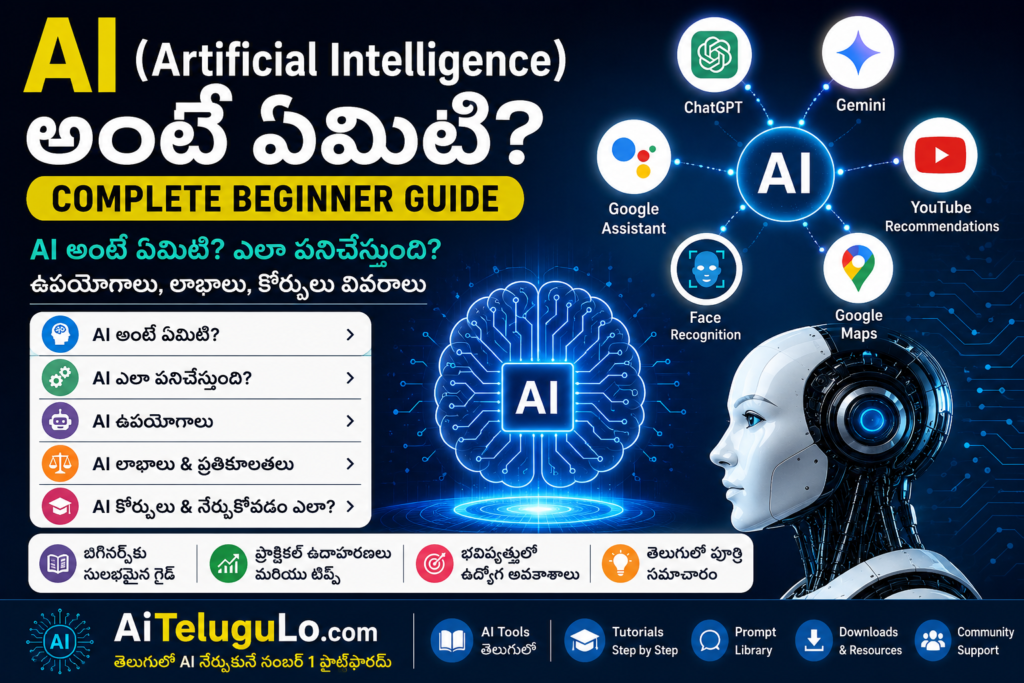
Machine Learning Algorithms పూర్తి తెలుగు గైడ్ 2026
కృత్రిమ మేధస్సు (Artificial Intelligence) ప్రపంచంలో Machine Learning Algorithms చాలా ముఖ్యమైన పాత్రను పోషిస్తున్నాయి. ఇవి కంప్యూటర్లకు డేటా ద్వారా నేర్చుకునే సామర్థ్యాన్ని ఇస్తాయి. ఈ గైడ్లో Machine Learning అంటే ఏమిటి, ముఖ్యమైన Algorithms ఎవరవి, వాటి రకాలూ, ఉపయోగాలు, లాభాలు మరియు భవిష్యత్తు గురించి పూర్తి వివరంగా తెలుసుకుందాం.
Quick Answer – Machine Learning Algorithms అంటే ఏమిటి?
Machine Learning Algorithms అంటే కంప్యూటర్లు Explicitly ప్రోగ్రాం చేయకుండా, డేటా ద్వారా స్వయంగా నేర్చుకునే విధానాలు. ఇవి Mathematical మరియు Statistical Models ఆధారంగా పనిచేస్తాయి. ఉదాహరణకు: Linear Regression, Decision Trees, Random Forest, Neural Networks మొదలైనవి.
Machine Learning Algorithms ఎందుకు అవసరం?
ఇంటర్నెట్ నుండి స్మార్ట్ఫోన్ల వరకు ప్రతి చోటా డేటా పెరుగుతోంది. ఆ డేటాను అర్థం చేసుకోవడానికి, Decision Making చేయడానికి Machine Learning Algorithms చాలా సహాయం చేస్తాయి. ఇవి క్రమంగా నేర్చుకుంటూ మెరుగవుతాయి.
Machine Learning ప్రధాన రకాలూ
Machine Learning ను సాధారణంగా మూడు రకాలుగా విభజిస్తారు:
- Supervised Learning
- Unsupervised Learning
- Reinforcement Learning
1. Supervised Learning
ఈ విధానంలో లేబుల్ ఉన్న డేటాను ఉపయోగిస్తారు. ఉదాహరణకు, Students Marks ఆధారంగా Grade అంచనా వేయడం. Algorithms: Linear Regression, Logistic Regression, Support Vector Machines (SVM), Decision Trees.
2. Unsupervised Learning
ఇక్కడ లేబుల్ లేని డేటాను ఉపయోగిస్తారు. ఇది డేటాలోని Patterns లేదా Groups కనుగొనడంలో सहాయం చేస్తుంది. ఉదాహరణలు: Customer Segmentation, Market Basket Analysis. Algorithms: K-Means Clustering, Hierarchical Clustering, PCA (Principal Component Analysis).
3. Reinforcement Learning
ఇది Reward-based Learning. ఒక Agent తన Environment నుండి Feedback పొంది మొదట తప్పులు చేస్తూ నేర్చుకుంటుంది. ఇది Robotics మరియు Gaming వంటి Applications లో ఉపయోగిస్తారు. Algorithms: Q-Learning, Deep Q-Networks (DQN).
Commonly Used Machine Learning Algorithms
- Linear Regression
- Logistic Regression
- Decision Trees
- Random Forest
- K-Nearest Neighbors (KNN)
- Naive Bayes
- Support Vector Machines (SVM)
- Gradient Boosting Machines
- Neural Networks
Machine Learning Algorithm ఎలా పనిచేస్తుంది?
- డేటా సేకరణ (Collect Data)
- డేటా ప్రాసెసింగ్ (Clean and Prepare)
- Algorithm ఎంపిక (Choose Model)
- Training
- Evaluation
- Prediction
Real-World Examples
- Bank Fraud Detection
- Email Spam Filtering
- Personalized Product Recommendations
- Voice Recognition Systems (Siri, Alexa)
- Chatbots మరియు ChatGPT వంటి Conversations
Machine Learning Algorithms యొక్క Benefits
- డేటా ఆధారంగా Quick Decision Making
- Automation ద్వారా సమయం ఆదా
- Predictive Analytics సామర్థ్యం
- Customer Experience మెరుగుదల
- Fraud Detection మరియు Security Enhancement
Step-by-Step Guide: Machine Learning Algorithm సృష్టించడంలో దశలు
- Problem Define చేయండి (ఉదా: Sales Prediction)
- Data Collect చేయండి
- Data Preprocessing చేయండి (Missing Values, Outliers Handle చేయండి)
- Feature Selection మరియు Feature Engineering చేయండి
- Training Dataset మరియు Testing Dataset గా Split చేయండి
- Algorithm ఎంపిక చేయండి (ఉదా: Random Forest)
- Model Training చేయండి
- Prediction Accuracy పరీక్షించండి
- Fine-Tuning చేయండి
Algorithm-wise Use Cases
| Algorithm | Use Case |
|---|---|
| Linear Regression | House Price Prediction |
| Logistic Regression | Customer Churn Prediction |
| K-Means | Customer Segmentation |
| Random Forest | Loan Approval Models |
| Neural Networks | Image Recognition |
Advantages & Disadvantages
Advantages
- Highly Scalable and Efficient
- Automation of Complex Processes
- Pattern Recognition in Big Data
- Improvement with Continuous Data
Disadvantages
- Requires Large Datasets
- Time-Consuming Training
- Expensive Hardware (GPU/TPU)
- Overfitting లేదా Bias సమస్యలు
Machine Learning Algorithms vs Deep Learning
| Parameter | Machine Learning | Deep Learning |
|---|---|---|
| Data Dependency | Medium Data | Huge Data అవసరం |
| Computation Power | CPU సరిపోతుంది | GPU అవసరం |
| Feature Engineering | Manual | Automatic |
| Explainability | అధికంగా ఉంటుంది | తక్కువగా ఉంటుంది |
Machine Learning & Artificial Intelligence సంబంధం
Machine Learning అనేది Artificial Intelligence లో భాగం. AI అంటే విస్తృతం, ML అంటే Data Learning భాగం. దీని ద్వారా AI Systems మరింత తెలివైనవి అవుతాయి.
Common Mistakes in Machine Learning Projects
- Too Little Data Usage
- Improper Data Cleaning
- Overfitting
- Ignoring Feature Scaling
- Improper Evaluation Metrics
Expert Tips
- Model ను సరైన Evaluation Metrics తో పరీక్షించండి (Accuracy, Precision, Recall)
- Cross-validation ఉపయోగించండి
- Feature Engineering పై దృష్టి పెట్టండి
- Model Interpretability పెంచండి
- AI Prompt Engineering వంటి కొత్త AI Concepts నేర్చుకోండి
Machine Learning Algorithms భవిష్యత్తు
2026 మరియు దాని తరువాత Machine Learning మరింత వేగంగా వృద్ధి చెందతుంది. Generative AI, Large Language Models, మరియు Google Gemini వంటి Advanced AI Models వల్ల Machine Learning Techniques మరింత Power పొందుతున్నాయి.
Multimodal Systems, Hybrid Models, మరియు Real-time Learning Techniques వంటి కొత్త Algorithm Approaches భవిష్యత్తులో ముఖ్యంగా ఉంటాయి.
Future Trends
- Explainable AI (XAI)
- Edge Machine Learning
- AutoML (Automatic Machine Learning)
- Ethical and Fair ML Models
- Integration with Large Language Models
Key Takeaways
- Machine Learning Algorithms అనేవి డేటా ఆధారంగా నేర్చుకునే Computational Models.
- ఇవి Supervised, Unsupervised, Reinforcement Learning రకాలుగా విభజించబడతాయి.
- వీటి సహాయంతో Automation మరియు Analytical Decision Making సులభమవుతుంది.
- భవిష్యత్తులో AutoML మరియు Deep Learning అనేవి ప్రధాన పాత్ర పోషిస్తాయి.
FAQs – Machine Learning Algorithms గురించి ముఖ్యమైన ప్రశ్నలు
1. Machine Learning Algorithm అంటే ఏమిటి?
ఇది డేటా ఆధారంగా నేర్చుకునే Mathematical విధానం, Predictive లేదా Decision Making కోసం ఉపయోగిస్తారు.
2. Machine Learning మరియు Artificial Intelligence మధ్య తేడా?
AI అనేది పూర్తి వ్యవస్థ, Machine Learning అనేది దాని భాగం – డేటా నేర్చుకోవడంలో ప్రత్యేకమైనది.
3. Machine Learning Algorithms నేర్చుకోవడం ఎలా ప్రారంభించాలి?
Python, Data Analysis, మరియు Basic Statistics నేర్చుకుని తర్వాత Algorithms అధ్యయనం చేయాలి.
4. Machine Learning కోసం ఏ Programming Language బెస్ట్?
Python మరియు R Languages అత్యంత విస్తృతంగా ఉపయోగించే Tools.
5. Machine Learning Algorithms ఎక్కడ ఉపయోగిస్తారు?
Healthcare, Finance, Marketing, E-Commerce, మరియు Chatbots వంటి చోట్ల విస్తృతంగా ఉపయోగిస్తారు.
6. Machine Learning భవిష్యత్తు ఎలా ఉంటుంది?
AutoML, Edge ML, మరియు Generative AI వంటి టెక్నాలజీల వృద్ధితో Machine Learning మరింత అభివృద్ధి చెందుతుంది.
Final Thoughts
Machine Learning Algorithms అనేవి ఆధునిక AI యుగానికి బలమైన Backbone. ఇవి మనిషి మాదిరిగా Data నుండి నేర్చుకుని కొత్త Predictive Systems సృష్టించడంలో సహాయపడతాయి. మీరు కూడా AI Developer గా కెరీర్ ప్రారంభించాలనుకుంటే, డేటా అవగాహనతో పాటు Algorithm Selection పై దృష్టి పెట్టండి.
Machine Learning నేర్చుకునే ఆసక్తి ఉన్నవారు మా గైడ్ AI Learning Path for Beginners ను చదవండి.
అంతిమంగా చెప్పాలంటే, Machine Learning Algorithms తో భవిష్యత్తు డేటా ఆధారిత నిర్ణయాల ప్రపంచం మరింత తెలివిగా మారబోతోంది.
CTA – Next Step
ఈరోజే Machine Learning నేర్చుకోవడం ప్రారంభించండి. Pythonతో మొదలుపెట్టి, చిన్న Projectలు రూపొందించండి. తర్వాత Neural Networks, Deep Learning వంటి Concepts లో ప్రవేశించండి. మా AiTeluguLo.com లో Machine Learning, AI Tools, మరియు ChatGPT వంటి Guides మీరు Step-by-Step నేర్చుకోవడానికి ఉపయోగపడతాయి.
ముందుగా ఇవి కూడా చదవండి
AI ప్రపంచంలో ప్రతి రోజు కొత్త టెక్నాలజీలు వస్తున్నాయి. ఈ టాపిక్ను ఇంకా బాగా అర్థం చేసుకోవడానికి ముందుగా ఈ గైడ్స్ కూడా చదవండి.
- PromptPerfect Tool అంటే ఏమిటి? Features, Benefits & Guide 2026
- AI Learning Path for Beginners – AI నేర్చుకోవడానికి పూర్తి తెలుగు గైడ్
- Personalized AI Chatbot అంటే ఏమిటి? పూర్తి తెలుగు గైడ్ 2026
- Freelancers కోసం Best AI Tools 2026 పూర్తి తెలుగు గైడ్
- SEO Automation Tools తెలుగు గైడ్ | స్మార్ట్ SEO కోసం ఉత్తమ టూల్స్
ఇలాంటి AI, టెక్నాలజీ మరియు డిజిటల్ ప్రపంచానికి సంబంధించిన తాజా సమాచారాన్ని తెలుసుకోవడానికి AiTeluguLo.com ను సందర్శించండి.